
Onion Soup and Nero Wolfe
🇮🇹 Leggi questo articolo in italiano
In Milan, October seems to have forgotten that it’s October.
The calendar says autumn began more than a week ago. The days are already getting shorter, the afternoon light has turned more golden, and for weeks now shop windows have been filling with chocolate brown, burnt orange, charcoal grey and burgundy. Everything, in short, seems ready for autumn.
Everything except the temperature.
And for someone like me, this is starting to feel personal.
I hate summer. I know, it’s not the sort of declaration one makes lightly. But I don’t like the heat, I feel no nostalgia whatsoever for days that seem to go on forever and, above all, I have never understood why fine weather should come with some sort of moral obligation to go out.
I, as a rule, am perfectly happy at home.
Of course I go out. I travel when I can. I see people. I do all the things normally functioning members of society are supposed to do. But given the choice between an evening out and an evening at home with a book, it is by no means certain that going out will win.
Perhaps that is one of the reasons I have always liked Nero Wolfe.
My first Wolfe, however, wasn’t one I met in a book.
He had William Conrad’s face.
I watched him on television as a child, in the early Eighties. I remember very little about the plots of those TV shows. Wolfe himself, though, I remember perfectly: enormous, gruff, methodical and, above all, firmly convinced that almost anything worth doing could be done without leaving the house.
Archie Goodwin, his assistant, dashed around New York, questioned people and followed leads. Wolfe stayed in his brownstone on West 35th Street and, whenever possible, let the world come to him.
After all, he had far more important things to do.
There were the orchids, for a start.
Not a few pots dotted around the place, but an entire collection housed in the plant rooms on the top floor of his brownstone. Wolfe devoted four hours a day to his orchids, from nine to eleven in the morning and from four to six in the afternoon. Two daily appointments that were virtually untouchable. A client might be waiting, a case might need solving, there might even be a murderer on the loose: the orchids still had their allotted time.
There was something wonderfully unreasonable – and at the same time perfectly reasonable – about a man capable of making the rest of the world fit around his schedule rather than allowing the rest of the world to dictate it.
And then there was food.
Fritz Brenner, his Swiss chef, wasn’t simply there to prepare lunch and dinner. Wolfe and Fritz discussed menus, ingredients, cooking methods, herbs and alterations to recipes with the utmost seriousness.
In Nero Wolfe’s house, a murder and what to have for dinner could be discussed with equal gravity.
That, I have to say, has always struck me as entirely sensible too.
Many years later, I found him again in Rex Stout’s novels.
My sister came across some of my old Mondadori Gialli at a second-hand market and brought them home for me, knowing I would love them. Books with yellowing pages which, besides the story printed inside them, seem secretly to contain another one: the story of all the lives they passed through before reaching ours.
Among them was a 1950 edition of Morto che parla.
The onion soup, however, goes back much further. It appears in the very first Nero Wolfe novel, Fer-de-Lance, published in 1934 and released in Italy as La traccia del serpente. So, in a sense, it was there from the very beginning: along with Archie Goodwin, the orchids, Fritz Brenner and that whole small domestic universe from which Wolfe would spend decades trying to stray as little as possible.
What had stayed with me most was the situation in which the soup appeared. Whenever Wolfe sank into one of his moods, one of two things could happen. Either he took to his bed and lived practically on bread and onion soup, or he retreated to the kitchen with Fritz, where the two of them would discuss food and cook.
I hadn’t thought about that soup in years.
My son was the one who brought it back to me.
A few days ago, he pointed out that the soup trend had already taken over social media at the beginning of September, despite our temperatures still hovering around twenty-five degrees.
After seeing so many of them, he wanted one.
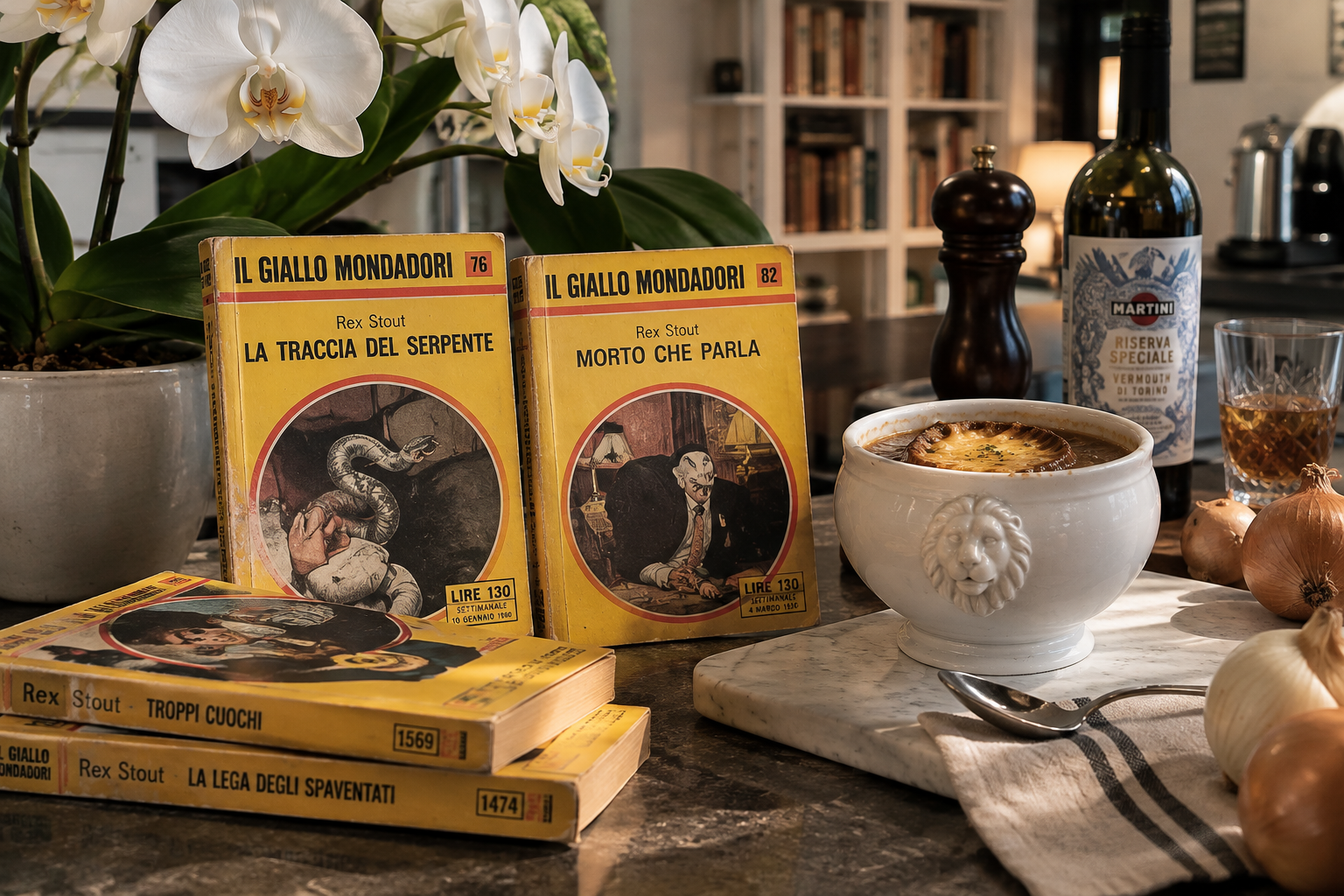
And so he asked me to make onion soup.
I, on the other hand, immediately thought of Nero Wolfe. Then I remembered that somewhere in the house I also had Il ricettario di Fritz Brenner, the cookbook devoted to Wolfe’s Swiss chef.
I found it and went looking for the recipe.
There it was.
At that point, the whole business began to take on proportions my son probably hadn’t anticipated when he simply said he fancied some soup.
First of all, I needed vermouth.
I didn’t have any, so I went out specifically to buy a bottle for deglazing the onions.
Then I decided that if I was going to make onion soup, I might as well take the word “onion” seriously.
I bought white onions, yellow onions and red onions. Then shallots. And, while I was at it, I added the white part of a leek.
I sliced them, crying as I went, cooked them slowly in butter, deglazed them with vermouth and added thyme.
At some point, the kitchen finally began to smell like the month written on the calendar, even if outside Milan was still stubbornly doing its best impression of August.
Then came the moment when I decided to betray both Brenner and Wolfe.
Because in Wolfe’s recipe, there is no French bread topped with cheese.
I, however, had bought a baguette.
And Emmental.
I sliced the bread, toasted it, covered it with cheese and finished the soup in the traditional way.
There was just one problem left: my daughter.
Emmental didn’t stand a chance with her.
Mozzarella, on the other hand, did.
So when she asked me what kind of cheese was on top, I replied, with complete composure, “Mozzarella.”
She ate the soup.
She even had seconds.
There are times when being a mother requires firmness. Others when it calls for diplomacy. And then there are times when you simply have to lie about the cheese.
Nero Wolfe, I imagine, would have disapproved of quite a few things: the mixture of onions, perhapsthe leek, and certainly the baguette with Emmental.
As for the deception, though, I think he might have recognised a certain professional competence.
And as we ate, I realised that the soup had brought together far more things than I had expected.

There was my son and a trend he had seen on social media. My daughter, convinced she was eating onions topped with melted mozzarella. There were the old Mondadori Gialli my sister had found at a second-hand market all those years ago. There was Fritz Brenner’s cookbook, filled with the dishes Rex Stout imagined for his detective. And much further back, there was William Conrad, whom I had watched on television as a child.
Most of all, there was Nero Wolfe, who after all these years still strikes me as an extraordinarily reasonable man.
He tends his orchids for four hours a day. He reads. He discusses what to have for dinner with Fritz with the seriousness other people reserve for life-changing decisions. He keeps strict hours. Hehates being disturbed. And he regards leaving the house as an option to be considered only after every other possibility has failed.
On that point, he and I have always understood each other perfectly.
So I wait.
I wait for the cool air, avenues covered in fallen leaves, shorter days and that wonderful feeling that staying at home is no longer something you have to justify.
In the meantime, though, I cooked autumn for myself.
With white, yellow and red onions, shallots, a leek, a bottle of vermouth bought especially for the occasion, and some Emmental travelling under an assumed identity.
Would Nero Wolfe have had something to say about it?
Yes.
But, of course, to tell me so he would have had to leave the house.
— Angela
Note on the images
The images accompanying this article were created from real photographs, then reworked and adapted to the content of the article with the assistance of artificial intelligence.