
The Case of the Missing Comment (and Edgar Allan Poe’s Lesson)
🇮🇹 Leggi questo articolo in italiano Il caso del commento scomparso (e la lezione di Edgar Allan Poe)
Anyone who loves detective stories knows that things are not always what they seem.
Sometimes the culprit is right in front of everyone’s eyes. At other times, it is a seemingly insignificant detail that makes all the difference. And then there are those cases in which the object everyone is searching for is not hidden inside a safe, behind a secret compartment, or concealed behind a painting… but is simply there, in plain sight.
That is exactly what happens in one of Edgar Allan Poe’s most famous stories, a classic many of us have probably read at least once, perhaps in a school anthology or a collection of his works. The Purloined Letter, published in 1844, is set in Paris during the first half of the nineteenth century, most likely during the July Monarchy. Poe never gives a precise date or explicitly reveals the names of the characters, but the clues scattered throughout the story suggest that the events take place in the royal apartments of Paris, sometime between the 1830s and 1840s. The woman at the centre of the story is clearly the Queen, while the character whose imminent arrival sets everything in motion is almost certainly the King, although Poe carefully avoids naming either of them.
The woman is reading a letter containing extremely compromising information — a letter her husband must never see. When she hears him approaching, she has no time to hide it. In order not to arouse suspicion, she leaves it on the table, hoping it will appear to be nothing more than an ordinary letter.
At that very moment, Minister D. enters the room. He is a man of extraordinary intelligence and equally extraordinary lack of scruples. With a single glance, he understands the situation. He takes out one of his own letters, places it beside the woman’s, and, with a gesture that is both simple and daring, takes the compromising letter and walks away.
The theft happens right in front of the woman, who cannot stop him. If she protested or tried to take the letter back, she would reveal to her husband that the document was important — and, above all, that she had something to hide.
From that moment on, Minister D. possesses a powerful weapon: he can use the letter to blackmail the woman — the Queen herself.
The police know exactly who the culprit is. They even know where he lives. What they cannot do is find the letter.
A meticulous, almost obsessive search begins. The officers take apart furniture, measure drawers, look for secret compartments, examine books, paintings, walls, tables, chairs, and even cushions. Every inch of the house is inspected, because they are convinced that a man as clever as the minister must have created a perfectly hidden hiding place.
But they find nothing.
This is where Auguste Dupin enters the story, the brilliant detective created by Poe and considered the forerunner of Sherlock Holmes. Through his analytical method and his ability to think beyond conventional patterns, Dupin immediately understands the investigators’ mistake.
If the minister is truly as intelligent as everyone believes, he knows exactly how the police think. He knows they will search for a secret compartment, a hidden safe, or some ingenious hiding place. So he chooses the most brilliant hiding place of all: he leaves the letter in a simple letter holder, where anyone can see it. He alters its appearance, stains it, changes the seal, and makes it look like a worthless piece of paper. Everyone sees it, but no one imagines that it is the very letter they are looking for.
It is one of the most brilliant insights in the history of detective fiction: sometimes what we are searching for is not hidden at all. It is simply invisible because we are looking at it in the wrong way.
When I am behind the scenes of my blog, I sometimes feel a little like the Chief of Police in Poe’s story, because something very similar happens on my own website.
No compromising letters disappear, of course, but dozens of comments left on my articles seem to vanish.
Or at least, that is how it appears.

A few days ago, for example, I was trying to bring some order back to the more than 250,000 comments that had accumulated on my blog over the years. The vast majority of them were spam, unwanted advertising, and automated messages. While trying to navigate through that digital maze, I came across a comment related to one of the articles I had written about the mystery surrounding Lady Diana’s death.
It was in English. Very short.
It was not the usual spam message, nor one of the many generic compliments that occasionally appear.
It said only:
“Things are not exactly as they seem. Contact me and I will explain.”
After spending so much time investigating Lady Diana’s death, piecing together testimonies, possible motives, and different theories, it was almost impossible not to be intrigued by a message like that. Curiosity immediately took over. I decided to check the author’s profile, look at the email address, and find out whether it was a genuine reader or yet another misleading message.
And that was exactly when the mystery began.
With a few clumsy clicks — my investigative skills when it comes to WordPress are, I must admit, practically non-existent — the comment disappeared.
Or at least, that is what I thought.
Like the Chief of Police in Poe’s story, I began searching everywhere, convinced that it must have been hidden somewhere in a remote corner of the blog. Yet the real challenge was not finding a clever hiding place, but letting go of the assumption that such a hiding place had to exist.
The truth was much simpler: the comment was merely buried among the hundreds of thousands of messages accumulated over the years. It was so visible that it had become almost impossible to see.
Just like Poe’s stolen letter.
What bothered me most was not simply losing a comment, but the thought that I might have missed a unique opportunity. That mysterious sentence — “Things are not exactly as they seem. Contact me and I will explain.” — could have been nothing more than a joke. But it could also have come from someone who had actually been close to Lady Diana’s world: a former servant, a butler, a member of her staff, or someone who had known her circle personally.
It was an unlikely possibility, of course, but not an impossible one. And that was precisely why I kept thinking about that missing comment.
Only after several days of searching did I manage to find it again.
It had been there all along.
I was finally able to reply, although I fear that the reader will probably never see my answer: more than three years had passed since the message was originally posted.
I will never know whether those few words really hid some revelation about Lady Diana’s death. But that small episode reminded me of a lesson Poe understood almost two centuries ago: sometimes what we search for most desperately is not hidden in the most secret place, but is right in front of us.
It is our own mind, convinced that the solution must be complicated, that prevents us from seeing it.
To be completely honest, I must confess something else as well: I had not visited the “behind the scenes” area of my blog for almost two years. When I decided to start writing again, I found my website’s administration area looking like a real cold case: thousands of notifications and an endless digital landfill filled with advertisements, online casinos, miracle cures, “guaranteed” investments, and every kind of website I would never dream of visiting.
But while searching for the mysterious Lady Diana comment, I began finding many other messages I had never answered.
Not because I had ignored them, but because they had been buried beneath a mountain of spam.
Once again, just like Poe’s letter, they had always been there — hidden in plain sight.
What surprised me most was discovering how many of those messages had come from readers in the United Kingdom, the United States, Canada, Australia, and other English-speaking countries.

Some shared their thoughts about books, others offered different interpretations or suggested new readings. Many thanked me for the care I put into researching the stories I write about and complimented my writing style. Reading those words again after so much time was deeply moving.
Some readers had even added the blog to their favourites and were patiently waiting for new articles.
I must admit that this discovery made me feel a little guilty.
I manage the blog entirely on my own, and WordPress has always been my weak point. I have never received any formal training, and I have learned everything along the way, through trial and error and more than a few inevitable difficulties. For me, every hidden setting or unfamiliar feature can become a small mystery to solve.
But knowing that someone had taken the time to write to me and had never received a reply genuinely saddened me.
This is also why I decided to do something I had never done before in all these years: translate one of my articles into English.
I do not pretend to write perfect English, but I would like those readers to know one simple thing: my silence was never a sign of indifference.
Perhaps the author of the Lady Diana comment will never read my reply. By the time I found it again, more than three years had already passed. And perhaps I will never know what story was hidden behind those few words.
But if even one of the readers I unexpectedly rediscovered happens to read this translation and understands the reason for my silence, then this small experiment will have been worthwhile.
Because, in the end, the most beautiful part of this blog is not the mysteries I write about, but the people who continue to share them with me.
Angela
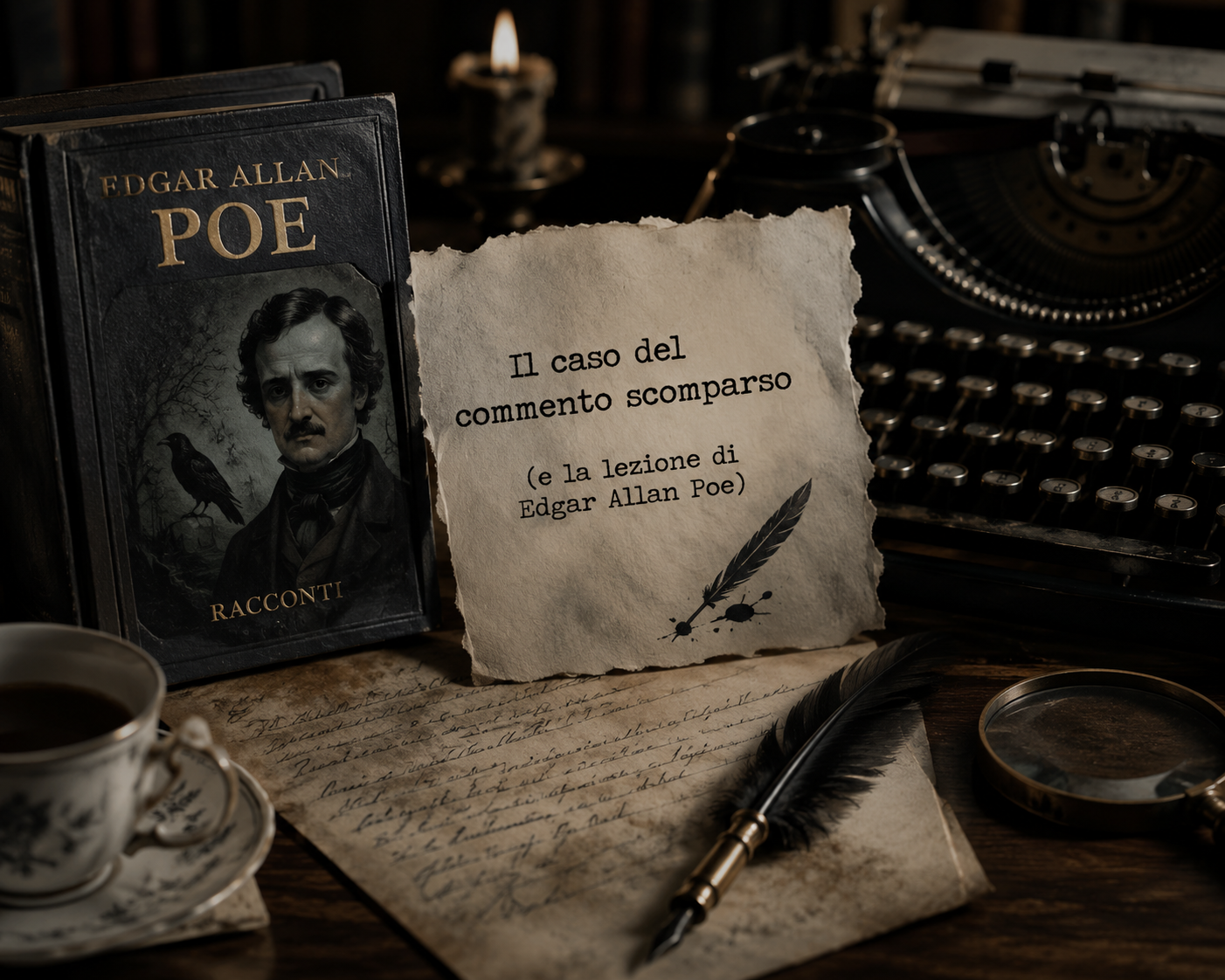
A note about the images: One more confession. Besides translating one of my articles into English for the very first time, I decided to try something else for this post. The images accompanying it were created with the help of artificial intelligence. I was simply curious to see whether it could capture and bring to life the atmosphere I had imagined while writing.